

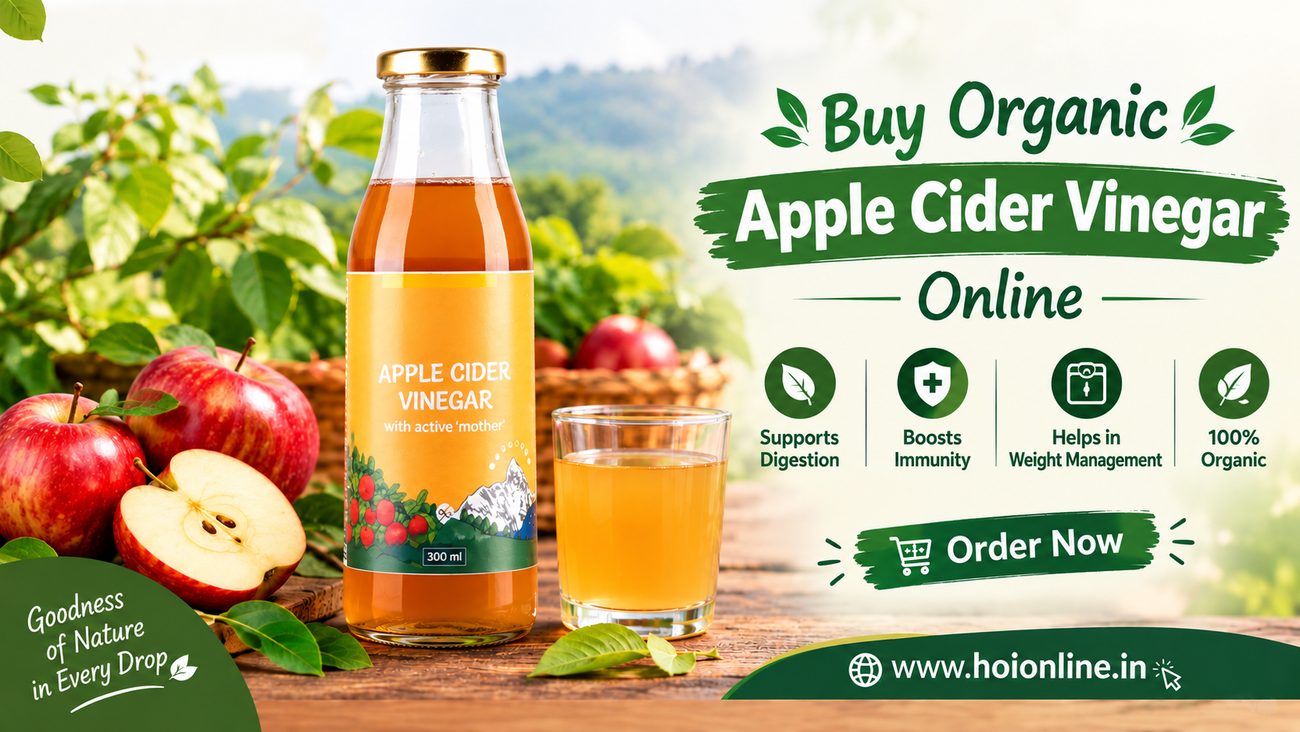
Buy Organic Apple Cider Vinegar Online
Search for apple cider vinegar online and you’ll get hundreds of results in under a second. Bottles at ₹199. Bottles at ₹899. Almost every one of them uses the same three words on the label: organic, raw, and unfiltered.
So how do you actually tell them apart?
The honest answer is that most of the difference comes down to two things nobody puts in the product title: where the apples came from, and how the vinegar was made. This guide walks through both — and what to look for before you add anything to your cart.
What Apple Cider Vinegar Actually Is?
Apple cider vinegar, or ACV, is what you get when apple juice is fermented twice. First, natural sugars in the juice convert to alcohol. Then, that alcohol converts to acetic acid — the compound responsible for vinegar’s sharpness and most of its character.
Done slowly and traditionally, that process leaves behind something visible: a cloudy, cobweb-like strand floating in the bottle. That’s the mother — a living colony of beneficial bacteria and yeast formed during fermentation, along with the enzymes it produces.
Commercially filtered vinegar removes it, which is why cheap supermarket ACV looks clear and golden. Raw, unfiltered ACV looks murky by comparison. The murkiness is the point.
The Question Most ACV Listings Don’t Answer: Where Are the Apples From?
Here’s something worth checking on any bottle you’re considering. Several of India’s best-known ACV brands source their apples from outside the country — some list Spain as the country of origin right on the product page. The vinegar may well be good, but the apples travelled a long way, and they’re typically commercial high-yield varieties bred for volume and transportability.
Himalaya Organic India takes the opposite route. HOI’s apple cider vinegar is made from heirloom apple varieties grown in biodynamic orchards in the high Himalayas — older cultivars naturally high in pectin and enzymes, grown in mountain conditions rather than shipped across continents.
Heirloom varieties matter here. They make available nutrients that conventionally grown, high-yielding modern varieties simply don’t carry in the same measure. It’s the same principle as heirloom tomatoes or native rice: older varieties are usually less productive and more flavourful, which is exactly why industrial agriculture moved away from them.
What to Check Before Buying Apple Cider Vinegar Online?
A short checklist that cuts through most of the marketing noise:
Does it say “with mother”? If the listing doesn’t mention it, assume the vinegar is filtered. Raw and unfiltered ACV should visibly contain sediment.
Is it liquid ACV or a tablet? Gummies and effervescent tablets are a different product entirely, usually containing a small amount of ACV plus added ingredients. If you want apple cider vinegar, buy the vinegar.
Where do the apples come from? Most listings don’t say. The ones that do are usually telling you because they’re proud of the answer.
What’s the bottle made of? Glass protects better than plastic against both light and leaching.
Is the price per ml, not per bottle? A 750ml bottle at ₹499 and a 300ml bottle at ₹335 are not competing on the same terms. Work out the per-ml cost before comparing.
Does the seller explain how it’s made? Handcrafted, slow-fermented vinegar is usually described in some detail. Mass-produced vinegar rarely is.
What ACV Is Genuinely Good For?
Apple cider vinegar has accumulated a lot of claims over the years — some reasonable, many exaggerated. Here’s the more grounded version.
- Digestive comfort. Many people find that diluted ACV before or with meals helps with the heavy, bloated feeling after eating.
- A useful daily ritual. A teaspoon in warm water in the morning is a simple, low-effort habit that some people find settling.
- Genuinely excellent in the kitchen. This gets undersold. ACV is a superb ingredient — in salad dressings, marinades, chutneys, and vinaigrettes, where its fruitiness works better than plain white vinegar.
- Beneficial bacteria and enzymes, present in raw unfiltered ACV via the mother, which filtered vinegar lacks.
A fair note: ACV is a food, not a treatment. It’s a good addition to a balanced diet — not a weight-loss solution, a blood sugar medication, or a substitute for medical advice. If you’re managing a specific health condition, talk to your doctor before making it a daily habit, particularly if you’re on medication.
How to Use It?
If you don’t know how to use it then don’t worry. Here, we give some tips on how to use Apple Cider Vinegar properly. Please check:
Shake the bottle first. The mother settles at the bottom — that’s normal, and it’s the part you want.
Start small. One teaspoon in a full glass of warm water. Not more, and never undiluted.
Timing. Morning, on an empty stomach, works for most people. Some prefer it just before meals.
Protect your teeth. ACV is acidic. Drink through a straw if you’re having it daily, and rinse your mouth with plain water afterwards — don’t brush immediately.
Use it in cooking. A tablespoon in a salad dressing, a splash in a marinade, or a spoonful to lift a chutney. This is the easiest way to get it into your routine without thinking about it.
Where To Buy Organic Apple Cider Vinegar Online?
There are many places or website from where you can purchase apple cider vinegar online but if you want 100% organic and pure apple cider vinegar then you must visit Himalaya Organic India (HOI). You can also visit our site www.hoionline.in and get best quality organic products.
Why Buy HOI’s Apple Cider Vinegar Online?
HOI’s ACV is a 300ml bottle at ₹335, and here’s what’s behind that:
- Heirloom Himalayan apples from biodynamic orchards — not imported commercial varieties.
- Handcrafted, not industrially produced at volume.
- With active mother — the live colony of bacteria and yeast intact, not filtered out.
- Part of HOI’s wider range of biodynamically farmed products, including Handcrafted Organic Apple Jam from the same orchards and Himalayan Herb Fusion Herbal Tea.
- Free delivery on all products, with cash on delivery available on orders over ₹500.
Explore the full Vinegar category or browse all HOI products.
Buy Apple Cider Vinegar Online
Most ACV bottles tell you what’s in them. Very few tell you where it came from. HOI’s apple cider vinegar comes from heirloom apples grown in biodynamic Himalayan orchards, handcrafted with the mother intact — which is a longer, slower way of making vinegar, and the reason it tastes and behaves differently from what you’ll find at the bottom of a marketplace listing page.
Frequently Asked Questions (FAQs) on Apple Cider Vinegar Online
Please check some best frequently asked questions on apple cider vinegar online.
What is the “mother” in apple cider vinegar?
It’s the colony of beneficial bacteria and yeast that forms during natural fermentation, visible as cloudy strands in the bottle. Filtered vinegar has it removed; raw, unfiltered ACV keeps it.
Is cloudy apple cider vinegar a sign it’s gone bad?
No — the opposite. Cloudiness and sediment mean the mother is present and the vinegar is unfiltered. Clear ACV has been processed to remove it.
How much apple cider vinegar should I have per day?
Start with one teaspoon diluted in a glass of water. Never drink it undiluted, and don’t assume more is better.
Does apple cider vinegar need refrigeration?
No. Store it in a cool, dark place away from direct sunlight. The acidity keeps it stable on its own.
Why do ACV prices vary so much online?
Mostly because of what’s in the bottle. Filtered vinegar made from concentrate is cheap to produce. Raw, unfiltered vinegar from heirloom apples, fermented slowly, is not. Compare per-ml and check whether the mother is included.
Can I use apple cider vinegar in cooking, or only as a drink?
Absolutely in cooking — it’s arguably where ACV shines most, in dressings, marinades, and chutneys.